Every executive I talk to has the same concern about deploying AI: "What if it makes things up?"
It is the right question. AI hallucination is real, it is measurable, and it remains the single biggest barrier to enterprise trust in language models. But most explanations I see online either oversimplify it ("the AI is lying") or bury it in academic jargon that does not help you build better systems. Here is what is actually happening, and what to do about it.
What hallucination really means
When a large language model hallucinates, it generates text that sounds confident and fluent but is not grounded in fact. It might cite a paper that does not exist, invent a statistic, or confidently describe a product feature that was never built. As a comprehensive survey from Alansari and Luqman puts it, hallucination is the "generation of content by an LLM that is fluent and syntactically correct but factually inaccurate or unsupported by external evidence."
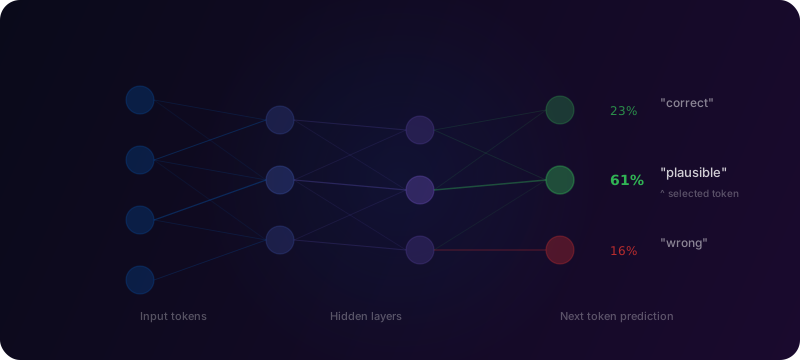
The key insight: the model is not lying. Lying requires intent and knowledge of the truth. An LLM is doing something fundamentally different. It is predicting the most probable next token based on patterns in its training data. It has no internal fact database to check against. Every single token is a probabilistic prediction. When those predictions align with reality, we call it "correct." When they do not, we call it "hallucination." From the model's perspective, the process is identical.
Why it happens
In my experience, most teams treat hallucination as a mysterious glitch. It is not. Recent research has traced it to specific, identifiable causes.
Training incentives reward guessing. OpenAI researchers demonstrated that next-token prediction objectives and benchmark leaderboards actively penalise "I don't know" responses. Models learn to bluff rather than hedge, because guessing scores higher on evaluations. The researchers compare it to students guessing on difficult exam questions rather than leaving them blank. The incentive structure makes hallucination rational (from the model's perspective).
Specific circuits misfire. Anthropic's interpretability team discovered something fascinating when they looked inside Claude's internal mechanisms. The model's default behaviour is actually to refuse to answer, stating it has insufficient information. A competing "known entities" feature activates when the model recognises something (like a person's name), overriding that refusal. Hallucinations occur when this recognition feature misfires: the model recognises a name without possessing relevant facts, suppresses its own "I don't know" response, and then confabulates a plausible answer. This reframes hallucination from random noise into a specific, traceable circuit failure.
Architecture has inherent limits. Autoregressive models process text in one direction, which limits contextual comprehension. Soft attention mechanisms struggle with long sequences, causing what researchers describe as "degraded reasoning or factual inaccuracies." Even the training objective itself (maximum likelihood estimation) fails to penalise factual inconsistencies directly.
Data gaps get filled with plausible fiction. When training data is sparse on a topic, models fill the gap with content that sounds right. This is worse in low-resource languages and multimodal contexts, where hallucination rates spike significantly compared to English text.
Real-world consequences
I have seen hallucination cause real problems in production systems:
- Legal risk: a model citing non-existent case law (Google's Bard once incorrectly claimed the James Webb Space Telescope captured the first images of an exoplanet, a claim that was trivially falsifiable)
- Medical misinformation: generating plausible but incorrect clinical information, where IBM researchers have flagged risks like misidentification of lesions leading to unnecessary interventions
- Engineering failures: recommending API parameters that do not exist, leading to debugging sessions chasing phantom features
- Eroded trust: one bad hallucination in a client-facing system can undermine months of AI adoption work
The common thread: hallucination is most dangerous when the output sounds authoritative. Users trust fluent, well-structured text, especially when it comes from a system they have been told is intelligent.
How to mitigate it
You cannot eliminate hallucination entirely with current architectures. But the field has made serious progress. Here is what works in production, informed by the latest research.
Retrieval-Augmented Generation (RAG) with verification. Basic RAG (giving the model source documents to answer from) is now table stakes. The frontier has moved to span-level verification, where each claim is checked against retrieved evidence at the sentence and phrase level. In my experience, the quality of your retrieval pipeline matters more than the generation model. Invest in good chunking, embedding models, and relevance ranking first.
Constrained generation. Limit what the model can output. Use structured output modes or function calling rather than free-form text. Provide explicit options when you need the model to choose. The less freedom the model has to generate arbitrary text, the fewer opportunities for hallucination.
Calibration-aware training. New reinforcement learning approaches score cautious, evidence-backed answers higher than verbose unsupported ones. One NAACL 2025 study found that training on synthetic hallucination-prone examples dropped hallucination rates significantly without hurting output quality. This is a fundamental shift: instead of hoping models will be accurate, we train them to recognise and avoid their own failure modes.
Factuality-based reranking. Generate multiple candidate responses, evaluate them with lightweight factuality metrics, and select the most faithful option. This approach lowers error rates without retraining, making it practical to deploy against existing models.
Evaluation loops. Build automated evaluation into your pipeline. Google DeepMind's FACTS Grounding benchmark showed how to do this systematically: first check whether the response adequately addresses the user's request, then verify factual accuracy against source material. Teams I work with implement a version of this as a second LLM call that checks whether each response is supported by the provided context.
The real goal: calibrated uncertainty
The most important shift I have seen in the past year is philosophical. The field has moved away from pursuing "zero hallucinations" toward managing calibrated uncertainty. The goal is not a model that never makes mistakes. It is a system that knows when it might be wrong and signals that transparently.
Anthropic's interpretability work points the way: if we can identify the internal circuits responsible for hallucination, we can strengthen a model's ability to refuse gracefully rather than confabulate confidently. That transforms refusal from a fragile prompt trick into a learned behaviour.
Hallucination is not a reason to avoid AI. It is a reason to engineer AI systems properly. The organisations getting the most value from language models are not waiting for hallucination to be "solved." They are building systems with appropriate guardrails, evaluation, and human oversight.
If you are working through these challenges with your team, I help organisations design AI systems that handle hallucination gracefully. Let's talk.