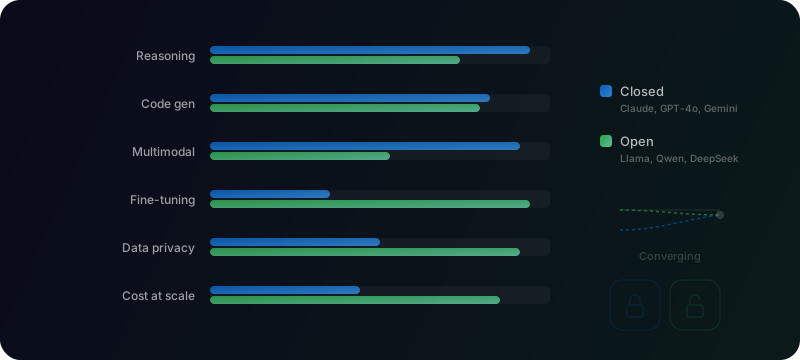
Two years ago, choosing an AI model was simple: if you wanted the best, you paid for a closed API. In 2026, that assumption no longer holds. Open-weight models have closed the capability gap so dramatically that the decision now hinges on your constraints, not on raw performance alone.
Here is how I help clients think through it.
The gap is real, but shrinking fast
As of early 2026, closed models (Claude, GPT-4o, Gemini) still lead on complex multi-step reasoning and multimodal tasks. That frontier advantage is real, and teams that need the best general-purpose capability should acknowledge it.
But the gap is narrower than most executives assume. Nathan Lambert's analysis at Interconnects found that open models consistently trail the best closed systems by about six months in absolute performance. That lag has held roughly stable since 2024. It has not widened, even as labs like Anthropic, OpenAI, and Google pour billions into training. Logarithmic scaling relationships between compute and performance help explain why: throwing ten times more resources at training does not yield ten times better results.
The practical implication is significant. For most enterprise tasks (classification, extraction, summarisation, code generation, domain Q&A), a six-month lag is irrelevant. You do not need a frontier model to route support tickets or summarise legal documents.
Where open models have pulled ahead
UC Berkeley's California Management Review published research identifying three structural advantages that open models hold over closed alternatives, advantages that closed systems cannot easily replicate.
Cost disruption. The economics are stark. DeepSeek V3 reportedly cost roughly $5.6 million to train, while estimates for GPT-5 exceed $500 million. At the inference layer, open models like Llama 3 70B run at approximately $0.60 per million input tokens, compared to $10 or more for GPT-4. In my experience, teams processing millions of tokens daily see 70 to 90 per cent cost reductions after migrating high-volume workloads to self-hosted open models.
Customisation and competitive moats. When you fine-tune an open model on your proprietary data, you create something your competitors cannot replicate by calling the same API. I have seen this play out repeatedly: a fine-tuned 8B parameter model trained on a client's domain data outperforms a general-purpose frontier model on that client's specific tasks. Specialised open variants are emerging across industries. Med-Qwen2-7B shows improved clinical diagnostic accuracy, and Fin-R1 achieves strong financial reasoning performance.
Data sovereignty. For regulated industries (healthcare, legal, financial services, government), keeping data on your own infrastructure is not a preference. It is a requirement. Open models make this possible without sacrificing capability. The Berkeley research highlights a deeper strategic risk with closed models: you depend on vendor decisions you cannot control, from pricing changes to unexpected performance degradation.
Where closed models still win
Closed models remain the right choice in several clear scenarios.
Frontier reasoning. For the hardest problems (complex analysis, nuanced instruction following, tasks requiring broad world knowledge), closed models maintain an edge. If your use case demands the absolute best available capability, closed APIs deliver it today.
Speed to production. A three-person team that needs to ship in two weeks should not be standing up GPU infrastructure. Closed APIs give you production-ready models with managed scaling, monitoring, and enterprise support. As Microsoft's enterprise comparison notes, closed models provide production-ready SLAs and elastic scaling that require significant operational maturity to replicate with open alternatives.
Multimodal capabilities. Gemini's native multimodal architecture and GPT-4o's vision capabilities are still meaningfully ahead of open alternatives for complex image understanding, video analysis, and audio processing.
The ecosystem is shifting beneath your feet
The open model ecosystem transformed in 2025. DeepSeek R1, released under an MIT licence in January 2025, catalysed a wave of open licensing adoption, particularly among Chinese labs. Qwen 3 overtook Llama in total downloads and became academia's preferred fine-tuning base. Meta reports over 650 million Llama downloads and more than 85,000 derivatives on Hugging Face.
Enterprise adoption is following. According to HatchWorks, 41 per cent of enterprises plan to increase open-source model usage, while another 41 per cent would switch if open model performance matches closed alternatives. Over 45 per cent of AI startups already operate hybrid stacks, using closed APIs for public-facing features and fine-tuned open models for backend processing.
The competitive landscape among closed providers is also shifting. Enterprises are moving beyond defaulting to a single vendor. Anthropic is gaining ground in compliance-heavy sectors, while organisations increasingly adopt multi-model strategies to reduce vendor dependency. The trend is toward AI as invisible infrastructure, where the competitive advantage comes from how you integrate models, not which single provider you choose.
The hybrid approach
The most effective teams I work with do not treat this as an either-or decision. They run a tiered architecture:
- Closed models for complex, low-volume tasks. Strategic analysis, nuanced reasoning, creative work where frontier capability justifies the per-token cost
- Open models for high-volume, domain-specific tasks. Classification, extraction, summarisation, and other workloads where a fine-tuned smaller model matches or beats a general-purpose large one
- Routing layers that direct requests to the right model based on task complexity, data sensitivity, cost, and latency requirements
This gives you frontier capability when you need it and cost efficiency plus data control when you do not.
Making the decision
Start with your constraints, not your preferences. If compliance requires data to stay on your infrastructure, open models are your path. If you need to move fast with a small team, closed APIs are your path. If you are processing millions of tokens daily on domain-specific tasks, the cost case for open models is compelling.
The model landscape in 2026 is competitive enough that there is no wrong choice, only choices with different trade-offs. The important thing is making those trade-offs deliberately rather than defaulting to whatever your team used last year.
If you are evaluating model strategies for your organisation, I can help you navigate the options and build an architecture that fits your constraints. Get in touch.